Apps · Health · Android
MigrenRadar: see migraine coming
Most apps record what happened. MigrenRadar goes a step further: it combines barometric pressure changes in your area with inputs like sleep and stress into a 0–100 daily migraine risk score, with a short morning alert. I live with chronic migraine myself. I built it to track my own condition, then shared it.
- Preparing for launch
- Data stays on your phone
- No ads
- No account needed
- English + Türkçe
- Not a medical device

Why MigrenRadar?
Prediction comes first
Pressure changes, sleep and stress combine into one clear risk score, so you know how the day may go before it starts.
Learns your personal threshold
Over time it learns your personal "load threshold" from your data and shows how far below or above it you are today.
Describes you, not the average
Test habits like water, caffeine timing and sleep on randomly ordered "apply / skip" days (n-of-1 experiments).
Privacy first
Data stays on your device by default, in encrypted SQLite. No cloud sync and no third-party trackers.
What it does
Radar: factors and attacks on one timeline
Sleep, stress, pressure and caffeine sit beside your attack days over the last 30 days, and your migraine fingerprint shows which pattern you resemble.
Daily risk score
A 0–100 risk from barometric pressure, sleep and stress inputs, plus a morning notification.
Warning signs (prodrome)
Mark signals that can arrive hours before the pain (yawning, neck stiffness, light sensitivity); it learns your personal warning sign.
SOS crisis mode
A one-tap, step-by-step calming guide in the middle of an attack. Free.
Mood and anxiety screening
Track depression and anxiety, migraine’s common companions, with the standard PHQ-2 / GAD-2 check-in. Free.
Drug-free early intervention
Slow breathing, low-stimulation visual rest and step-by-step muscle relaxation (PMR) with honest evidence labels. Does not replace your medication.
Medication tracking
Mark acute-medication days; it warns you gently if you approach the overuse range (ask your doctor).
MIDAS disability scale
A 5-question MIDAS scale shows how many days migraine kept you from work, housework and social life. Free.
Phenotype and attack report
A personal “migraine fingerprint” across sleep, weather sensitivity, trigger and warning-sign axes; last 30 days vs the 30 before; a per-attack summary of duration, peak severity and treatment response.
Doctor-ready summary
Turns findings into a readable summary you can share as a PDF, including program usage and medication adherence. The AI-free version runs entirely on-device.
Screenshots
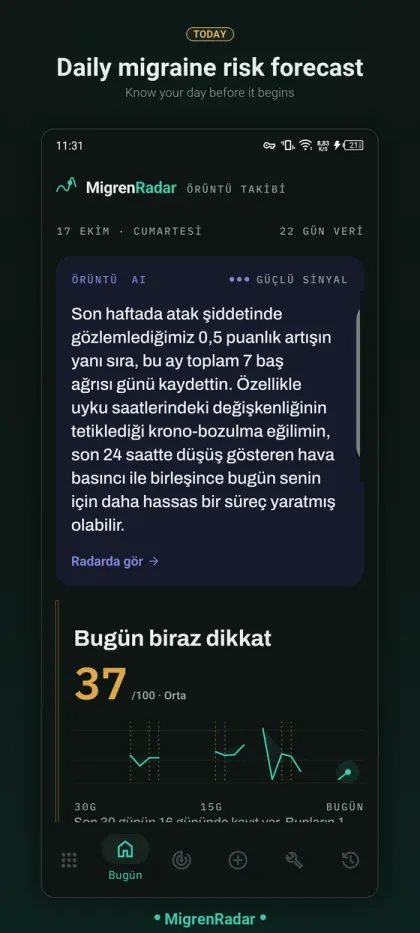
Today: risk score, AI insight and pressure trend 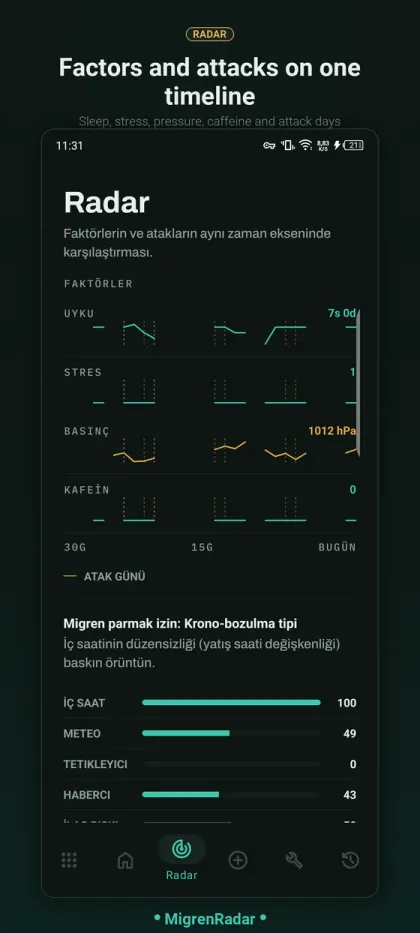
Radar: factors and attacks on one timeline 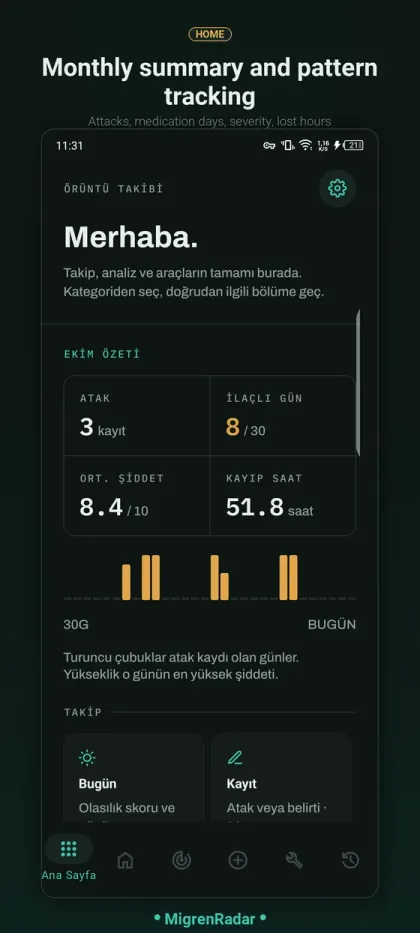
Home: monthly summary and attack bars 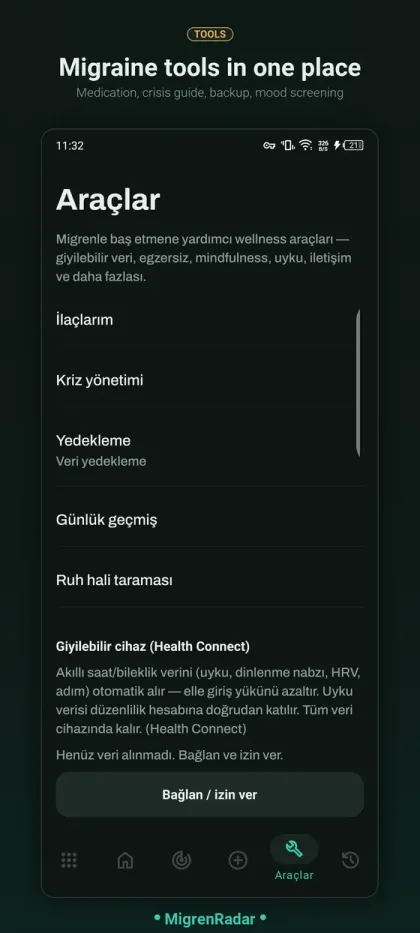
Tools: medication, crisis guide, backup, mood screening 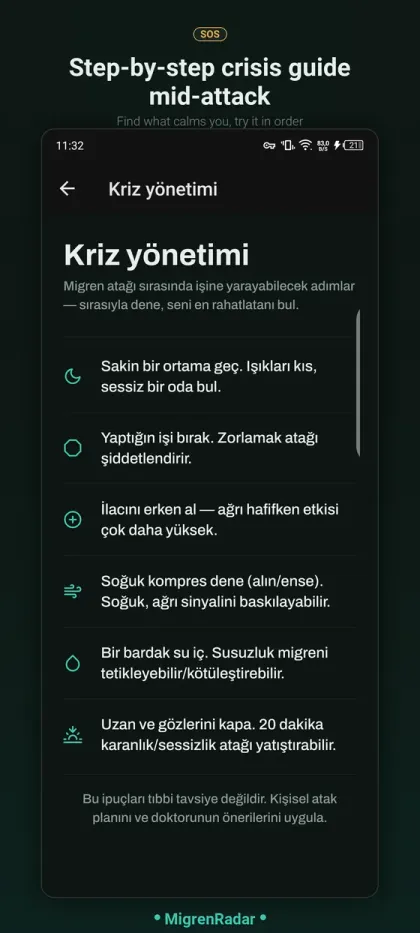
SOS: step-by-step crisis management mid-attack 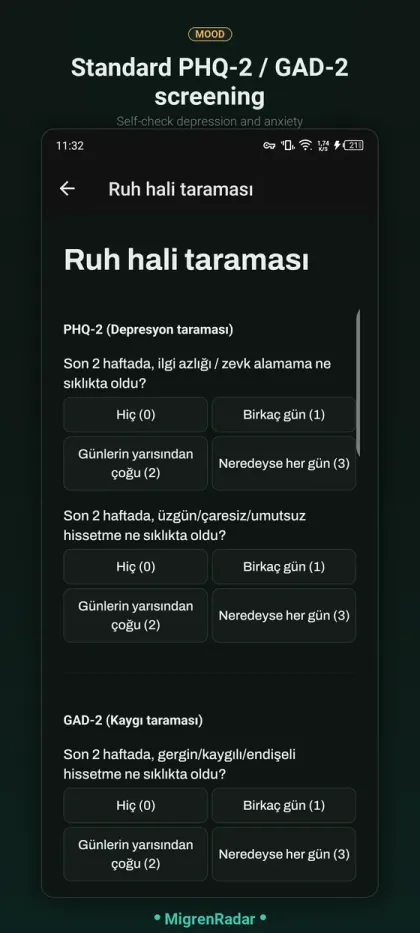
PHQ-2 / GAD-2 mood screening
Free and premium
Always free
- Risk score and weather data
- Daily check-in and attack log
- Morning notification
- Warning-sign marking
- Mood / anxiety screening
- SOS crisis mode
- Medication log and data backup
- MIDAS scale
With a subscription
- Personal experiments (n-of-1)
- Digital phenotype and prediction model
- Trigger detector and threshold learning
- Doctor summary and AI report
- Wearable and extra environmental signals
- Exercise, mindfulness, CBT-I and circadian coaching
Privacy
Health data is the most sensitive data there is, so MigrenRadar keeps everything on your device by default.
- Your data stays only on your device, in encrypted SQLite. No account and no cloud sync.
- No ads, no advertising ID, no third-party trackers and no data sale.
- Location is used only for the weather forecast and only coordinates go out; the app works without it too.
- The AI report is optional: bring your own key (Anthropic, Google, OpenAI or Groq); your raw journal, dates, location and name are never sent.
- Anonymous research contribution is entirely optional and off by default.
- Delete a single record or all your data permanently, or export it to an encrypted file.
Important
MigrenRadar is not a medical device and does not diagnose, treat, cure or prevent any medical condition. Consult a healthcare professional for medical advice, diagnosis or treatment. For a sudden, severe or unusual headache, don’t wait: see a healthcare professional.
Frequently asked questions
Does MigrenRadar treat migraine?
No. MigrenRadar is a wellness and personal-observation app; it does not diagnose or treat. The risk estimates and logs are meant as a summary that helps you talk with your doctor.
Where is my data stored?
By default only on your phone, in an encrypted database. You don’t create an account and there is no cloud sync. The AI report and research donation are optional and off by default.
How is the risk score calculated?
A 0–100 score comes from barometric pressure changes in your area combined with inputs like sleep and stress, and it learns your personal threshold over time. It is a probability estimate, not a certainty.
Is it free?
The risk score, check-in, attack log, SOS mode, mood screening, medication log and backup are always free. Advanced features such as personal experiments, phenotype, the doctor summary and the AI report sit behind an optional subscription (7-day trial).
Which devices does it run on?
Android. It can optionally pull sleep, heart rate, HRV and step data through Health Connect; you don’t have to connect one.