Thailand DTV Visa: Requirements, Cost and How to Apply
EnglishTürkçe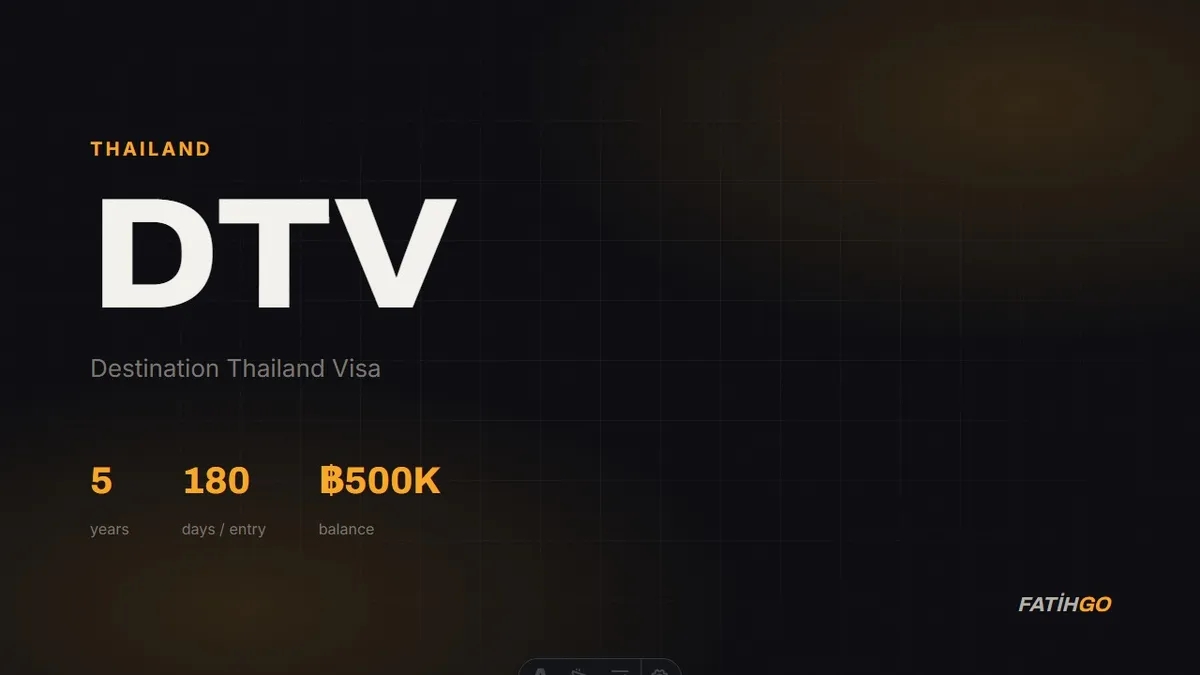
In short: The DTV (Destination Thailand Visa) is a 5-year, multiple-entry Thai visa for remote workers with foreign income and for people enrolled in a program of at least 6 months in Muay Thai, Thai cooking or medical treatment. Each entry allows 180 days, extendable once to 360 in total. You must show at least 500,000 THB in your account when applying (most consulates want it held for 3 months). The base fee is 10,000 THB, or $400 at the Ankara embassy. The visa does not allow work for Thai employers or Thai clients.
The Destination Thailand Visa (DTV) was announced in July 2024 as “finally a real visa for digital nomads.” I touched on it briefly in my ED visa guide but never gave it the standalone breakdown it deserves. Since the May 19 visa tightening raised the cost of staying in a “gray area,” these questions have been coming up more — this post pulls together what I’ve verified against official sources, in one place.
What the DTV Is, and Its Three Categories
The DTV sits between a tourist visa and a work visa, officially built for “workcation” — working while traveling. It has three sub-categories:
- Workcation: Digital nomads and freelancers working remotely for a foreign employer or foreign clients. Requirement: your income source must be outside Thailand.
- Thai Soft Power: Enrollment in a program lasting at least 6 months — Muay Thai, Thai cooking, medical treatment, seminars, or arts. Language courses alone don’t qualify; you need official enrollment documentation from the institution.
- Dependent: The spouse or child under 20 of someone holding either category above.
DTV Requirements: Who Can Apply, and What You Need to Prove
The requirement that surprises people most is financial: you need to show at least 500,000 THB (roughly $14,000 USD) in your account at application time. Most consulates want that balance seasoned for at least 3 months — transferring money in right before you apply generally doesn’t work.
Other required documents: a passport valid for at least 6 months with 2 blank pages, the application form, a photo, proof of your purpose (an employment/client contract, course enrollment letter, or medical appointment), and proof of your current residence.
How to Apply for the DTV: Process and Cost
You apply through the Thai embassy or consulate responsible for your country of legal residence — since 2025, most missions process applications through the e-Visa portal. You upload scanned documents, pay the fee, and are expected to respond quickly if additional documents are requested. Processing typically takes 3–7 business days.
The fee is where it gets confusing: the base fee is 10,000 THB, but some missions — Ankara included — charge a fixed USD amount instead of the local-currency equivalent. According to the Royal Thai Embassy in Ankara’s official page, the fee there is $400 USD, paid in cash — a fixed figure, not that day’s exchange-rate conversion of THB 10,000.
| Mission | Fee |
|---|---|
| General (missions charging in THB) | 10,000 THB |
| Ankara, Turkey (official source, 2024 update) | $400 USD (cash) |
Duration and Extension
The DTV is a 5-year, multiple-entry visa. Each entry gives you 180 days. You can extend that stay once, at an immigration office, up to a total of 360 days. Once that runs out, you have two options: leave and re-enter (starting a fresh 180-day period) or repeat that cycle for as long as the visa’s 5-year validity lasts.
What You Can’t Do
The DTV is not a work visa — this is the most common source of confusion:
- You cannot get a Thai work permit
- You cannot work for a company registered in Thailand
- You cannot do freelance work for Thai clients
All of your income has to be foreign-sourced — which is actually the DTV’s clearest advantage over the ED visa’s “gray area” work situation: the rules aren’t ambiguous here, they’re explicitly “legal,” just with a clearly drawn line.
DTV vs. ED vs. Tourist Visa
| DTV | ED Visa | Tourist (Visa Exemption) | |
|---|---|---|---|
| Purpose | Remote work + soft power activity | Formal enrollment in education | Short-term travel |
| Duration | 5 years / 180 days per entry | Tied to course length | 30 days (since September 15, 2026) |
| Remote work | Legal (foreign income required) | Gray area, risky | Not anticipated |
| Financial proof | 500,000 THB | Tuition + variable | Usually not required |
| Fee | ~10,000 THB (varies by mission) | Variable (school + visa costs) | Free/low |
| Best for | Remote worker with foreign income | Someone actually studying | Short-term visitor |
If your goal isn’t enrolling in a language school, the DTV is a far more clearly-defined alternative to the ED visa. But if you’re genuinely enrolling long-term in a formal institution, the DTV doesn’t substitute for that — the two are built for different purposes.
If you’ve applied for a DTV or are in the process, I’d genuinely like to hear about it through the contact page — a guide compiled from official sources isn’t the same as a real experience on the ground, and I’d like to update this with both.
Frequently Asked Questions
Can I work for a Thai company or Thai clients on a DTV?
Can I spend the 500,000 baht once the visa is approved?
How many times can the DTV be extended?
Should I get a DTV instead of an ED visa?
