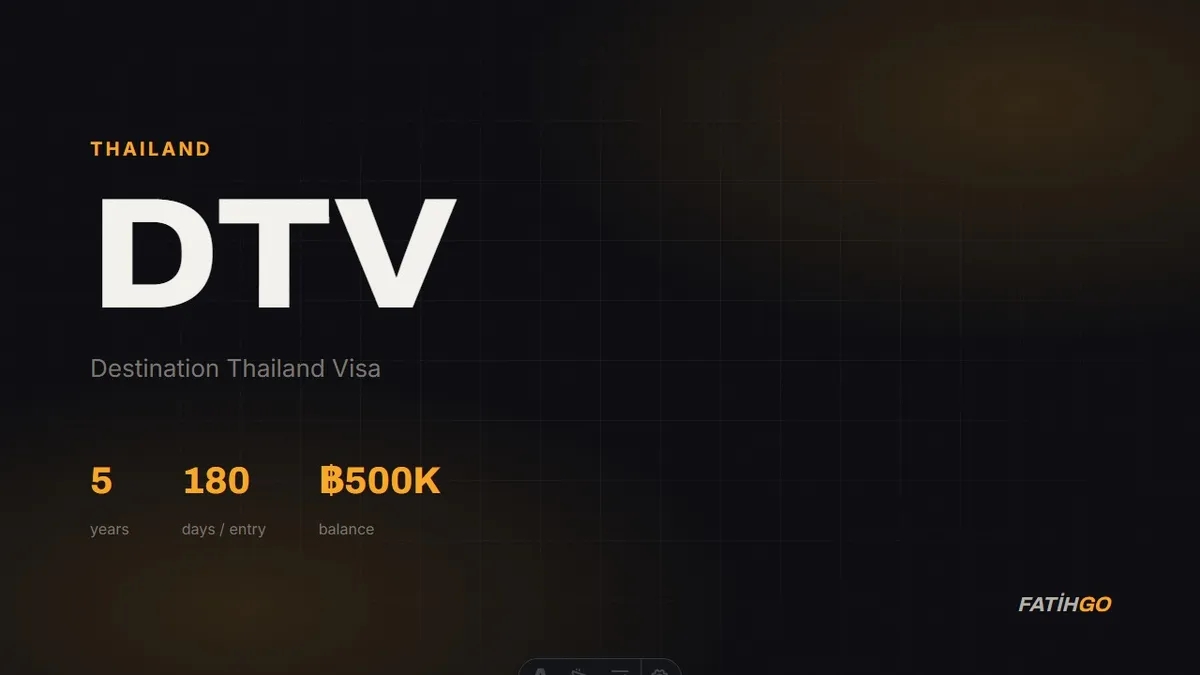
In short: Visa-free entry (30 days) for a short holiday, a tourist visa for a longer one, the DTV if you work remotely on foreign income, and the ED visa if you’ll genuinely study. All four differ in length, requirements and work rights; the table below puts them side by side.
Comparison Table
| Visa-free entry | Tourist visa | DTV | ED visa | |
|---|---|---|---|---|
| Purpose | Short holiday | Longer holiday | Remote work or soft power activity | Enrollment in a formal educational institution |
| Length | 30 days (since 15 Sept 2026) | 60 days (per published sources) | Valid 5 years, 180 days per entry | Initial stay of 90 days (single entry) |
| Extension | Once +30 days, 1,900 THB | Once +30 days, 1,900 THB (per sources) | Once, up to 360 days in total | Tied to course length |
| Application fee | None | Varies by mission | 10,000 THB; $400 at Ankara | About $80 at Ankara |
| Financial proof | 10,000 THB per person threshold | Varies by mission | 500,000 baht balance | Tuition and documents |
| Remote work | Not anticipated | Not anticipated | Legal (foreign income) | Gray area |
| Thai employer/clients | Not allowed | Not allowed | Not allowed | Not allowed |
| Best for | Short-term visitor | Holidaymaker staying beyond 30 days | Remote worker with foreign income | Someone actually studying |
Which Should You Choose?
- Under 30 days: Visa-free entry is enough. Complete the TDAC before you fly.
- 30–90 days of holiday: You can extend visa-free entry once (1,900 THB), but approval is at the officer’s discretion. For a safer plan, consider applying for a tourist visa in advance.
- Remote work on foreign income: the DTV. The 500,000 baht balance requirement and the right category (Workcation) matter.
- Genuinely taking classes: the ED visa. It comes with duties such as the 90-day report and TM.30.
What No Visa Gives You
Working for a Thai company or Thai clients without a work permit is not allowed on any visa type. Neither the DTV nor the ED visa changes that.
The Overstay Risk
Overstaying a visa or a visa-free stay costs 500 THB per day, capped at 20,000 THB. If you turn yourself in at departure, overstaying more than 90 days brings a 1-year entry ban, and the bans are longer if you’re caught. Details: ED visa guide.
Sources and Limits
The DTV and ED data come from the detailed posts on this site, and the visa-free data from the Royal Gazette publication and a comparison of secondary sources. The tourist visa’s 60 days and +30 extension come from published sources; for official confirmation, check the Ankara embassy or the e-Visa portal. Rules can change; this page was last updated on 4 November 2026.
Frequently Asked Questions
Which visa do I need to stay in Thailand longer than 30 days?
Is the DTV or the ED visa the better choice?
What's the difference between visa-free entry and a tourist visa?
What happens if I overstay?
If this guide helped you out
Related Guides
 Visas & Bureaucracy
Thailand ED Visa Guide: Long-Term Stay Through Education
How long can you stay in Thailand on an ED (education) visa, what documents do you need, and how does the 90-day report work? Current 2026 rules and real risks.
 Visas & Bureaucracy
Thailand Visa for Turkish Citizens: 30 Days Visa-Free (2026)
Turkish citizens need no visa for Thailand: 30 days visa-free since 15 Sept 2026, one 30-day extension (1,900 THB), the TDAC card and longer-stay options.
 Living & Housing
Your First 7 Days in Thailand: A Day-by-Day Survival Plan
From clearing the airport to a SIM card, a scooter rental, and staying safe on night one — a day-by-day, real-budget plan for your first week in Thailand.